

How to choose organic cosmetics: labels and ingredients
Équipe éditoriale
To choose organic cosmetics, you must know how to distinguish between natural origin and organic origin, and between a claim and a certification. Reading COSMOS labels and deciphering an INCI list then helps in choosing each skincare product according to your skin's real needs.
What does an organic cosmetic really guarantee?
An organic cosmetic contains ingredients derived from organic farming, in a proportion that varies according to the formulas. This qualification provides information on the production method of the raw materials. By itself, it says nothing about the quality of the formula for your skin.

Distinguishing natural origin from organic origin
An ingredient of natural origin is not necessarily grown according to the rules of organic farming. The origin of a material and its production method are two distinct criteria. This is why organic and natural cosmetics do not mean exactly the same thing.
In France, a product presented as a whole as "natural" must contain at least 95% natural or naturally derived ingredients. Below this threshold, the percentage must be indicated if the claim concerns the entire product, according to the DGCCRF's rules on organic and natural cosmetics.
Water, which is very present in creams and lotions, cannot be certified organic. A cream composed almost entirely of natural ingredients can therefore display a much more modest percentage of organic content. The two figures are read separately.
Understanding the scope of a certification
No mandatory and harmonized European definition defines organic cosmetics. An organic certification is based on voluntary standards that each brand chooses to follow. The NF ISO 16128-1 standards of April 2016 and NF ISO 16128-2 of December 2017 provide definitions and calculation methods, without being certifications in themselves, according to AFNOR and ISO.
All cosmetics sold in the European Union, whether certified or not, are covered by the same regulatory foundation. This framework requires a safety assessment before marketing, the appointment of a responsible person, and labeling rules. Organic cosmetic products are subject to this like all others.
Recognizing what organic does not prove
Highlighting a single organic ingredient does not demonstrate that the finished product meets the criteria of a certification. According to the DGCCRF, a general presentation as "organic" must be justified. A certification provides information on composition and production, without guaranteeing superior efficacy, better tolerance, or the absence of allergens.
Geographic origin calls for the same caution. Manufacturing in France does not mean that all ingredients are French or organic. Nor does it mean that all French organic cosmetics carry a certification.
How to verify organic cosmetic labels?
An organic label serves as a benchmark if it is precisely identified. The signature, the standard, and the certifying body each play a different role on the label. Distinguishing them helps avoid greenwashing and compare products with an equal level of requirement.
Reading COSMOS ORGANIC and COSMOS NATURAL
The COSMOS standard includes two signatures that do not have the same level of organic requirement. COSMOS NATURAL covers natural ingredients. COSMOS ORGANIC adds organic content thresholds, which ADEME details as follows:
- Natural origin: at least 95% ingredients of natural origin in the product.
- Ingredients that can be organic: at least 95% of them must come from organic farming. This threshold does not apply to the entire finished product.
- Finished product: a minimum organic share of 20% in the general case and 10% for certain rinse-off products.
Water and minerals are not included in the calculation of organic agricultural ingredients. A product rich in water can therefore comply with COSMOS ORGANIC while displaying a total organic share close to the minimum.
| Criterion, according to ADEME | COSMOS ORGANIC threshold | What the figure covers |
| Ingredients of natural origin | 95% minimum | The entire product |
| Organic ingredients among those that can be | 95% minimum | Only ingredients that can be certified organic |
| Organic share of the finished product (general case) | 20% minimum | The entire product, excluding water and minerals |
| Organic share of the finished product (some rinse-off products) | 10% minimum | The entire product, excluding water and minerals |
Locating other signatures
Cosmébio is an association linked to a label. Its new labeled products have followed the COSMOS standard since January 1, 2017. Ecocert acts primarily as a certifying body: its name verifies compliance with the standard and does not designate an organic level competing with COSMOS ORGANIC.
The private NATRUE standard distinguishes a natural level and an organic level, with 13 product categories. At its organic level, at least 95% of the natural substances concerned must come from certified organic farming or controlled wild collection. Nature & Progrès applies its own specifications and a participatory guarantee, which covers the entire farm or company.
Confirming a displayed certification
Green packaging or a pictogram evoking nature does not provide information on the level of certification. On the packaging, a few elements allow for verification, supplemented by an online search:
- The exact signature: look for the mention ORGANIC or NATURAL, not just the word COSMOS.
- The certifier: note the name of the organization that audited the product.
- The COSMOS database: search for the product in the database intended for consumers.
- The status: verify that the certification is indeed listed as valid.
The standard is also evolving. According to official COSMOS documents, version 4.2 has been applicable since September 1, 2025.
How to read the composition without making a mistake?
The INCI list catalogs all the ingredients of a cosmetic under an international name. It provides information on the nature of the formula, but not on the exact doses. Reading it correctly allows you to measure what a skincare product really contains.
Understanding the order of the INCI list
The list follows a precise logic, regulated by European regulation, which sets a few reading rules:
- Descending order: ingredients are classified according to their weight at the time of their incorporation.
- 1% threshold: below this, ingredients can appear in any order, after the others.
- Beginning of the list: according to the DGCCRF, the first three or four ingredients generally represent a large part of the product.
- No fixed percentage: an ingredient's position does not reveal its concentration.
The beginning of the list therefore gives the base of the formula, often water, humectants, or fatty substances. The rest requires more nuance.
Evaluating promises related to ingredients
An active ingredient placed at the end of the list is not necessarily useless, because its position says nothing about its interest in the formula. Conversely, the presence of plants does not prove their role. The DGCCRF noted a verbena highlighted at 0.0005% of the formula, when verbena perfume represented 0.4%.
According to the DGCCRF and Regulation (EU) 655/2013, a cosmetic promise must be based on evidence that is adequate and verifiable. Tests carried out on the finished product provide more direct information about it than studies devoted to a single ingredient.
Identifying perfume, allergens, and preservation
Perfume compositions appear under "parfum" or "aroma." Regulation (EU) 2023/1545 requires individual mention of the fragrance allergens concerned above 0.001% in a leave-on product. For a rinse-off product, this threshold is 0.01%. These labeling rules do not guarantee the absence of a reaction.
The minimum durability date applies when the product keeps for 30 months or less. Beyond that, the European cosmetic regulation normally provides for a period after opening: the "12M" symbol means 12 months after opening, not after purchase.
Which organic cosmetic should you choose for your skin?
A certification makes it possible to distinguish between products that meet the same need, but it does not replace that need. The choice of an organic cosmetic therefore begins with what your skin expresses: tightness, discomfort, sensitivity. Then come the formula and the routine.
Starting from skin needs
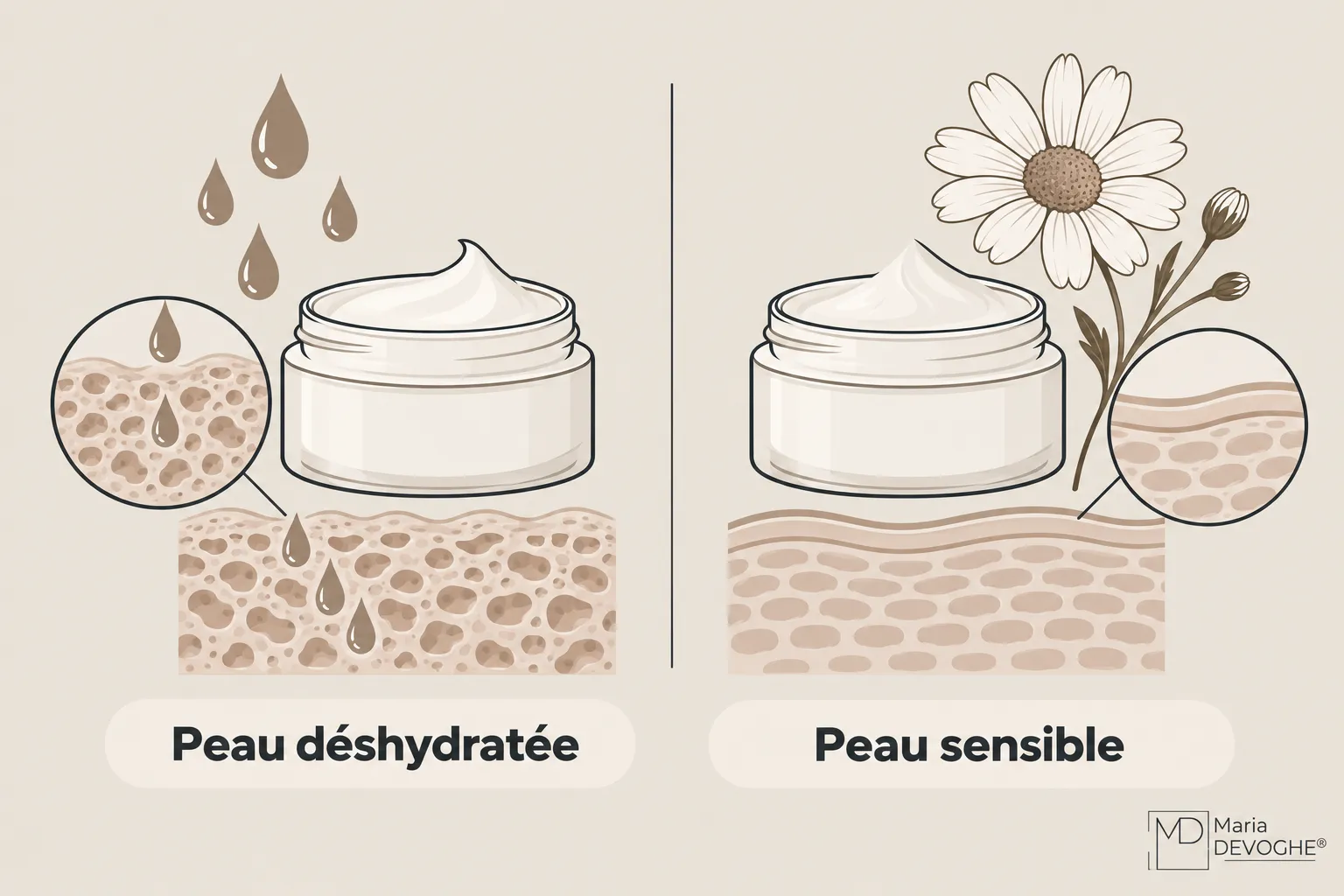
The choice of an organic cosmetic depends first on what the skin is lacking: dry skin lacks fatty substances, dehydrated skin lacks water. Humectants, such as glycerin, help retain water in the stratum corneum, which is essential for the skin barrier. Emollients soften this layer, and occlusive agents limit evaporation. Vegetable oils suitable for dry skin are not always suitable for skin prone to blemishes.
Matching the formula to your sensitivity
According to dermatological literature, perfumes and preservatives are among the significant causes of contact allergy related to cosmetics. The organic origin of the ingredients is therefore not enough to judge the tolerance of a formula.
For skin that tolerates certain products poorly, a few criteria help reduce sources of discomfort:
- A fragrance-free formula: it eliminates a frequent source of sensitization, without guaranteeing the absence of all allergens.
- Fewer active ingredients at once: a shorter formula limits the number of components to which the skin is exposed.
- The entire formula: surfactants, preservatives, pH, and fatty substances count just as much as the highlighted active ingredient.
In the event of a reaction, Dermato-INFO advises not to reapply the suspect product. If it persists, it recommends consulting a doctor and then, if necessary, a dermatologist or a dermato-allergist.
Building a consistent routine
Devoghe® targets its COSMOS certified routine for dehydrated skin at skin that is uncomfortable or prone to tightness. It brings together four steps in order: cleanse, spray the mist, apply the serum, then hydrate with the cream. The prebiotic facial mist contains 99% ingredients of natural origin and 7% ingredients of organic origin. Its INCI list includes glycerin, betaine, alcohol, and perfume.
A complete beauty routine also includes sun protection, which an organic label is not enough to evaluate. For this treatment, UVA protection, texture, tolerance, and daily pleasure of use count just as much. A randomized trial actually observed less skin aging with regular use of sun protection.
Frequently Asked Questions
How to compare two organic cosmetics before buying them?
Check the elements in this order: the intended use, the exact certification, tolerance, the formula, evidence of the promise, then the cost of use. Price per liter and price per use do not mean the same thing, because the quantity required for each application varies from one formula to another.
Do you need to replace your entire routine at once to switch to organic cosmetics?
It is not necessary. You can replace your products as they run out, rather than changing your entire routine at the same time.
Do claims like "paraben-free" or "not tested on animals" help in choosing an organic cosmetic?
Very little. According to the DGCCRF, "paraben-free" can be an unacceptable claim if it is unverifiable or unfairly disparages regulated substances. "Not tested on animals" does not help distinguish between products sold in Europe, where these tests are already prohibited. During an investigation, the DGCCRF noted anomalies in "free-from" claims in 40% of the 336 establishments checked.